Button Notation: A Common Language to Gain Edge

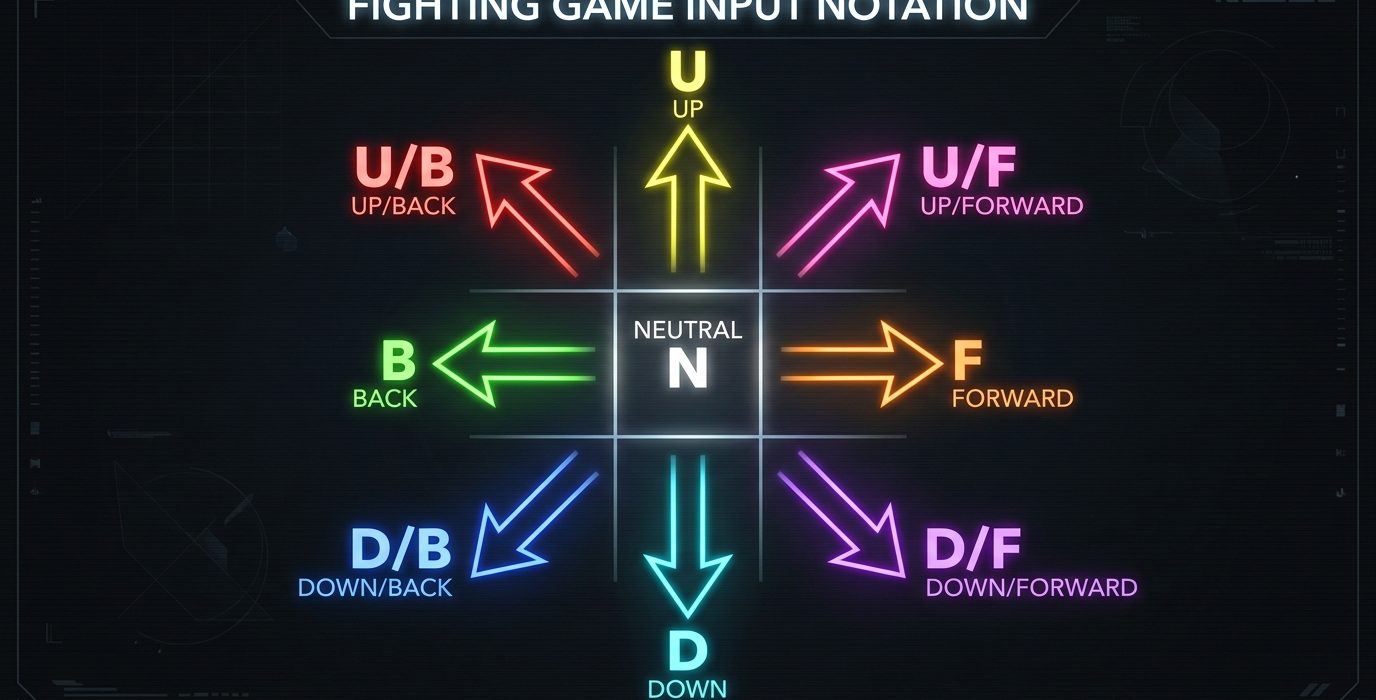
Button notation exists out of a simple but fundamental need: to communicate moves, combos and techniques in fighting games in a precise, fast and universal way, even across players using different controllers, different languages, or different versions of the game.
Fighting games are highly technical, and having universal notation allows players to analyze matches and explain concepts quickly and concisely, as well as to maintain a shared language on forums.
Movement or Directional Inputs
Movements are represented using directional letters (Note: uppercase directional letters mean the input must be held and not released, while lowercase means it can/should be released. Below they are written in uppercase for explanatory purposes only):
“N” or “n” = Neutral = ☆
“F” = Forward = →
“B” = Back = ←
“D” = Down = ↓
“U” = Up = ↑
Attack Buttons
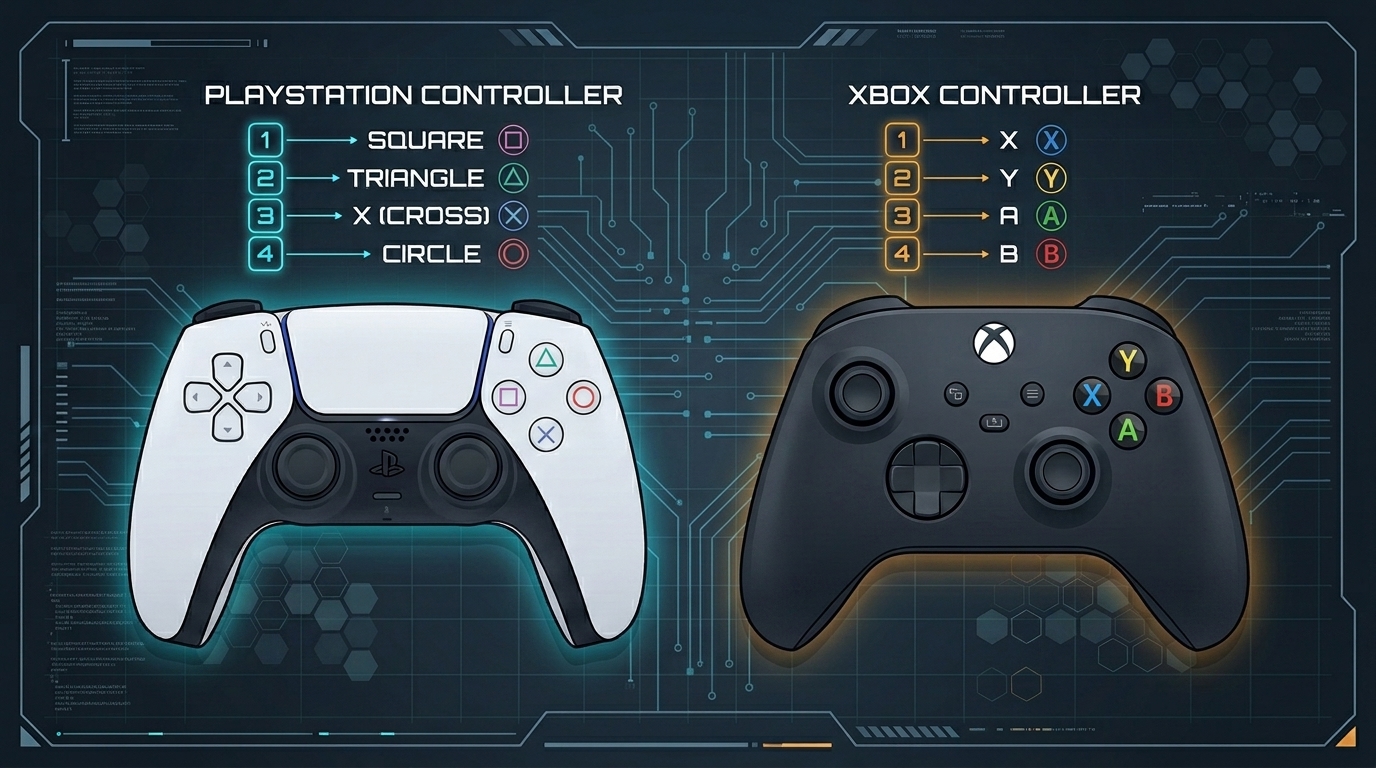
Attack buttons are represented by numbers 1 through 4, mapped as follows:
1 = Left Punch (LP) = □ (PS) or X (Xbox/PC)
2 = Right Punch (RP) = △ (PS) or Y (Xbox/PC)
3 = Left Kick (LK) = ✕ (PS) or A (Xbox/PC)
4 = Right Kick (RK) = ◯ (PS) or B (Xbox/PC)
Saying “Left, Right, triangle” can get confusing, “B,F,2” is far more concise and quicker to understand.
Input Combinations
Diagonals are combinations of two directions pressed simultaneously (one horizontal + one vertical, often written without a slash, or separated by a comma, though the latter is not technically the correct way to represent them).
↗ = Up/Forward = U/f (uf or u,f)
↘ = Down/Forward = D/F (df or d,f)
↖ = Up/Back = U/B (ub or u,b)
↙ = Down/Back = D/B (db or d,b)
So if, for example, you see:
Df 1 — the result would be ↘ □ or ↘ X (Xbox)
U/B 3 — the result would be ↖ ✕ or ↖ A (Xbox)
Why is the comma not really the correct notation?
We will cover this question after explaining the last point.

Simultaneous Attack Inputs
These are moves that require two or more buttons to be pressed simultaneously (not one after the other!) and are linked by the symbol “+”.
Example: 1+2 = Left Punch + Right Punch = □ + △ = X+Y
Df 3+4 = Down/Forward 3+4 = ↘ ✕+◯ = ↘ A + B
Now let’s go deeper into attack inputs, also covering several symbols not yet mentioned.
+ as already seen indicates the simultaneous pressing of multiple attack buttons.
/ is a visual variant to indicate a diagonal direction (specific to directions, not attack buttons).
~ refers to the quick press of the next attack button for the correct execution of the move (F 1~2 = → □~△ = → X~Y).
N or n refer to the absence of any directional input.
: indicates precise timing or a Just Frame input in attack buttons.
[ ] can indicate various things, but generally highlights the directions or buttons outside the brackets, e.g. “[df1,4],2” to show that the 2 has particular properties.
, (to come back to the comma question) tells the reader that those inputs must be pressed in sequence, one after the other. It can be used for both movement inputs and attack buttons.
Consequently, “d,f” does not mean ↘, but rather ↓,→
This is why commas should not be used for diagonal directions, they create ambiguity between inputs that should be pressed together and inputs that should be pressed in sequence.
Df,1 therefore does not mean ↘□ (or ↘X on Xbox), but rather ↘,□ (or ↘,X on Xbox), because the comma tells us to press them in sequence, NOT simultaneously.
Where can the comma be replaced?
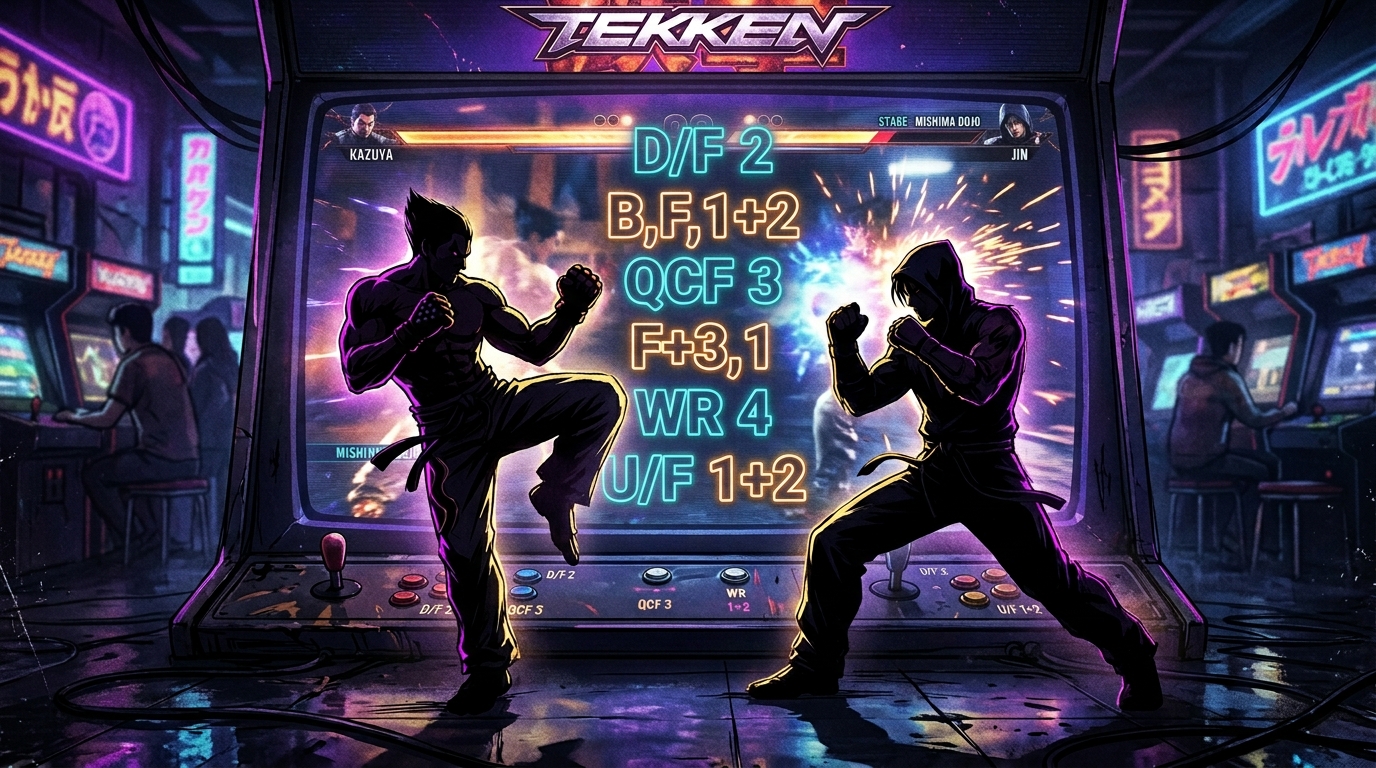
The comma serves to sequence inputs, but for complex motion inputs, such as the well-known Quarter Circles and Half Circles, a dedicated notation can be used instead of a chain of commas.
Also called Quarter Circle (Forward or Back in Tekken), abbreviated as “QCF / QCB”, and Half Circle (Forward and Back), abbreviated as “HCF” / “HCB” (or written out in full in beginner guides: ⇐⇙⇓⇘⇒ / ⇒⇘⇓⇙⇐), these abbreviations spare us from having to write ↓,↘,→, etc.
In Tekken only QCF, QCB, HCF and HCB exist. In other fighting games these motions are used to build even more complex inputs, such as Pretzel Motions (⇗⇒⇘⇓⇙⇐⇖⇘).
You are now equipped to read any guide and watch any video tutorial without wondering every single time whether those people are speaking an alien language!