
Tekken 8 Season 3: The Forgotten “Basics”

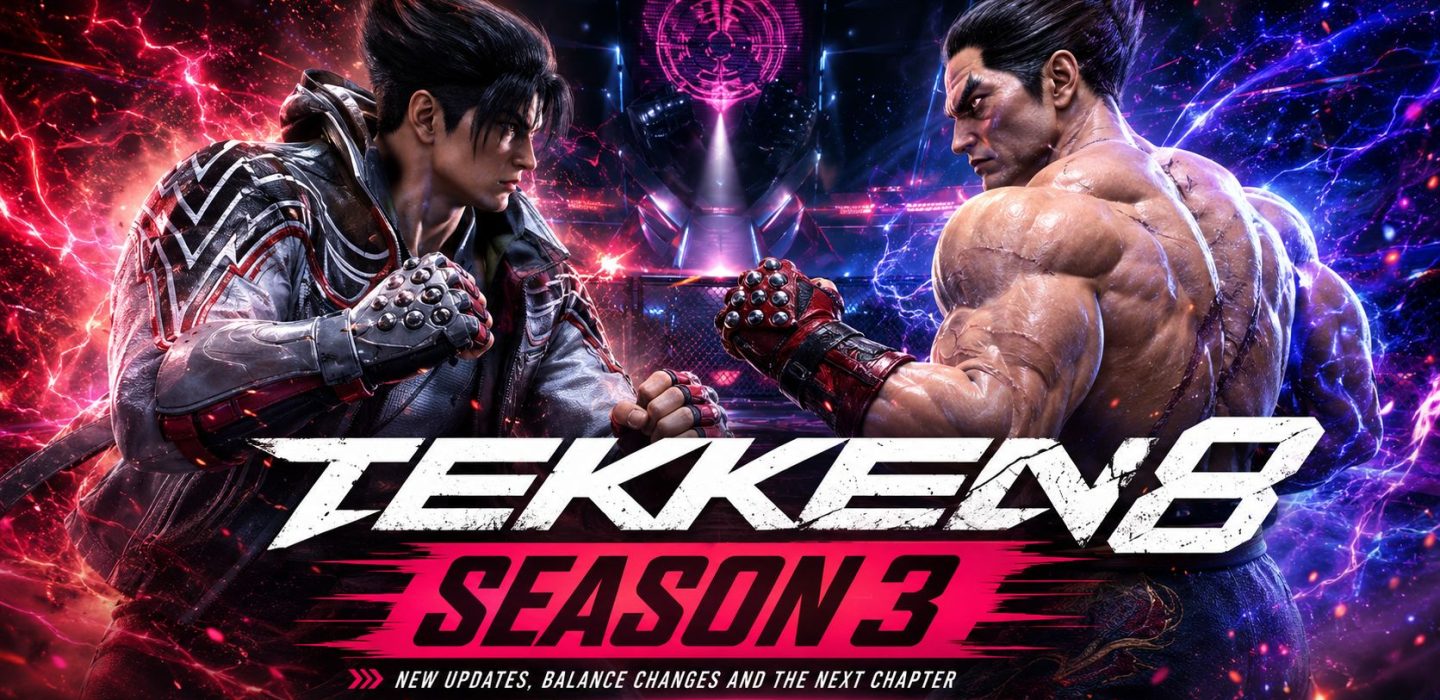
Tekken 8 Season 3: The Forgotten “Basics”
The Tekken 8 community is going through a phase of deep dissatisfaction, with increasingly sharp criticism directed at the developers’ choices.
But where does this situation come from? Let’s break down the causes, between broken promises and structural problems.
At launch, Tekken 8 presented itself as one of the most ambitious entries in the series, backed by a substantial budget and a clear direction: make the gameplay more aggressive, spectacular, and accessible.
Historically, the franchise has always tried to evolve with each installment, and after Tekken 7, increasingly dominated by a defensive, patient playstyle, this new direction was initially well received. Even the introduction of “recoverable health” seemed like a genuine attempt to balance out the previous game’s high combo damage.
However, as the months passed, certain design and balance choices began showing their limits, fueling growing frustration within the community.
The Heat System, for instance, introduces chip damage on block, further amplifying the effectiveness of offensive characters like Hwoarang and Law. The frame advantage on blocked hits after a Heat Dash was often excessive, drastically reducing defensive options and turning many situations into something closer to a 2D fighter than Tekken’s traditional structure. Similar dynamics occurred after a successful Heat Engager as well.
On top of that, certain elements of the Heat System and specific character moves ended up reshaping the matchup approach entirely, making the overall experience less coherent from a systemic standpoint.
Another major change was the systematic nerfing of most Counter Hit Launchers (Patch 1.04), intended to discourage overly passive play. The result, however, was the opposite of what was intended: reducing the threat of a counter hit removed most of the risk for the attacking player. With no need to respect the opponent’s turn, many matches devolved into sequences of relentless pressure that were often nearly impossible to interrupt.
Season 2 Winter: The “Defensive” Update
One of the community’s main requests was to rein in the excess of offensive pressure, trying to restore balance without necessarily stripping away the game’s aggressive identity.
On December 8, 2024, right alongside the Tekken World Tour finals (held in Shibuya, Tokyo), Bandai Namco capitalized on the community’s attention to drop the Winter Update trailer and officially announce Season 2, which arrived in Spring 2025 (on April 1st), hitting 16,091 concurrent players, the highest number seen in a year, a clear sign of just how high expectations were.
The developers had promised a “Major System Overhaul”, explicitly stating the goal was to give players more defensive tools. It looked like the turning point. But in the end?
The meta didn’t change. Despite small buffs to movement and recoverable health management, the Heat System remained a steamroller, and some moves were flat-out buggy or simply untested: Paul’s “Hammer of the Gods” (F1+2), for example, guaranteed unintended follow-ups even when blocked.
Calling Season 2 “defensive” ended up backfiring: players found themselves facing the same old problems (massive chip damage and problematic frame advantage), now with the added insult of a broken promise. Patch v2.00.02 landed on April 17, 2025, just 16 days later. It was explicitly labeled an “Emergency Patch,” meant to fix Jack-8’s and Paul’s “unintended” behavior, while also raising the max health of the entire roster.
Seeing an Emergency Patch in Tekken within two weeks is genuinely rare, a warning sign of just how far off the rails the balance had gone. Historically, the dev team has always preferred to wait for data from major tournaments, but with Season 2, the pressure was enough to force Harada into an immediate “tactical retreat”.
This was proof that the system had become indefensible even to the people who built it. Within less than a month of Season 2’s start, the player peak plummeted to under 5,800 players, the lowest point in the game’s history since launch, wiping out a further 15–20% of the monthly average player count.
Trying to win back community’s trust
Following this steep decline, the success of the new season stopped being just an opportunity and became a necessity. For the first time since launch, Tekken 8 found itself in a delicate position: having to win back its own community’s trust.
The developers chose to take their time. Over the following months, gathering player feedback, analyzing the meta, and fixing the most problematic interactions, an almost year-long wait was built up. A wait that inevitably raised expectations.
The official announcement came during the Tekken World Tour Global Finals 2025 in Sweden, where Bandai Namco unveiled the Season 3 trailer. The message was clear: “Back to Basics”. A return to Tekken’s foundations. A shift in direction from the previous seasons. An attempt to realign the game with its historical identity. On paper, exactly what the community had been asking for.
The trailer showed clear improvements to movement, with more effective sidesteps and greater consistency in lateral evasion. Further balance changes and new moves were also teased, aimed at scaling back some of the characters that had dominated in previous seasons, a significant signal, especially considering how little the meta had shifted during Season 2.
Alongside this, the new season’s first DLC character was introduced: Kunimitsu II, reimagined with an even more spectacle-driven design, featuring explosive kunai, upgraded weapons, and heightened visual effects. The trailer then confirmed the return of characters like Bob and Roger Jr., further expanding the roster.
In the months that followed, the developers published an official blog detailing the planned changes for Season 3, previewing part of the upcoming work on the game system. Among the community’s most requested changes was a nerf to Heat Smash, specifically, removing its ability to cause a wall splat, a mechanic many considered excessively punishing, especially in situations that already favored the attacker. Once again, the premises seemed to be heading in the right direction, riding the wave of community hype.
However, once the patch dropped, significant issues surfaced quickly. Problems that had already appeared in Season 2 and were patched two weeks later resurfaced, as with Jack-8, signaling that the earlier fixes hadn’t been fully effective. In other cases, clearly problematic interactions emerged: Feng, for instance, was able to chain Heat Smash even with an empty Heat bar, keeping around +12 on block, an extremely high value that severely limits the opponent’s defensive options.
Some new additions also behaved inconsistently: Heihachi’s new charged move, when executed quickly, had a speed comparable to the standard version but with a higher frame advantage. a property that, in theory, should have been exclusive to the charged variant.
These three unpleasant situations were fixed roughly 9 days after the patch’s release, once again highlighting shortcomings in the testing and polishing phase. Meanwhile, balance adjustments to the dominant characters turned out to be marginal, while some already-strong fighters, like Leo and Jun, received further buffs.
On top of this, there’s another critical issue: Heat Smash can still cause a wall splat under certain conditions: for example, when the first hit whiffs. This rule, however, doesn’t apply uniformly across the roster: just look at Jin, whose Heat Smash can still wall splat when it hits an airborne opponent. The result created a widespread perception of inconsistency with the patch’s stated goals.
The opinion of the Pros
The core problem wasn’t the presence of bugs, but their nature: elements that directly contradicted the very concept of “Back to Basics”. The backlash wasn’t long in coming, not even from professional players.
Knee (Korea) openly stated that “Season 3 can’t be fixed.” He reiterated that the game has lost its technical soul, turning into a “party game” where years of accumulated experience (legacy knowledge) count for nothing against indiscriminate offense.
Arslan Ash (Pakistan), while contributing to early tier lists, came across as deeply skeptical, voicing strong doubts about the game’s direction and pointing to the gap between the developers’ promises and the actual outcome.
Kkokkoma (Korea) became the symbol of the backlash. With the now-famous tweet, “9 months for this? You guys are so incompetent,” he called out the ineffectiveness of nearly a year’s worth of corrective patches, labeling as “incompetence” the failure to balance mechanics like the Heat System and the damage output of characters such as Dragunov and Feng.
Finally, Aris, a longtime commentator and a well-known figure in the competitive scene, reacted to the patch with sarcasm, pointing out that many of the current issues had already been predicted years earlier.
At this point, it’s hard to frame this as a matter of perception or opinion. The data, the in-game dynamics, and the community’s reactions all point to a fairly clear reality: Season 3 failed to deliver on the promises it was built on.
The problem, though, goes beyond any single update. It touches on the overall direction of Tekken 8, and the delicate balance between innovation and identity the series has always tried to preserve. “Back to Basics” was a specific commitment to a more readable, more coherent, more meritocratic philosophy of play. A commitment that, at least for now, hasn’t been fully realized.
An open question remains: is this a misstep within a broader journey, or a sign of a direction struggling to find itself again? The answer, as always, won’t come from promises, but from the facts. And, as of now, those “Basics” still look more like a stated idea than a concrete reality.